
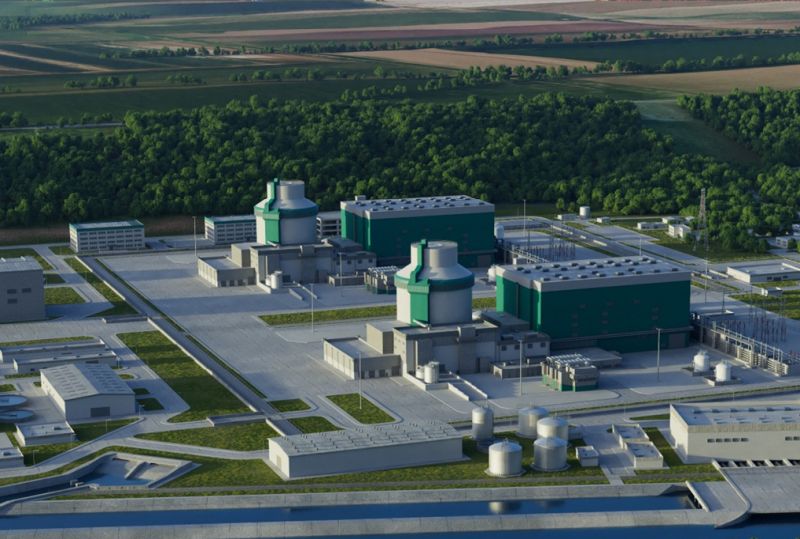
Kozloduy NPP Units 7 and 8: A Project with the Potential to Transform the Bulgarian Economy
In the October 2026 issue of Utilities Magazine, independent energy expert and former Minister of Energy Milko Kovachev published an in-depth macroeconomic analysis of the future of Kozloduy NPP Units 7 and 8. Based on the American AP1000 technology, the project is gradually moving from a political decision into the implementation phase.
According to Milko Kovachev’s analysis, the key question is no longer whether Bulgaria can finance the new units, but whether the economy is prepared to absorb and successfully implement an investment of such magnitude.
For the purposes of the macroeconomic model, a notional central estimate of EUR 20 billion has been used for the two units, equivalent to approximately 17% of Bulgaria’s gross domestic product (GDP). However, given that the investment will be spread over a decade, the actual annual burden on the economy remains significantly lower, peaking at around 2.1% of GDP in the most intensive construction years.
One of the main conclusions of the analysis is that the project’s greatest challenge will not be securing the necessary capital, but ensuring the availability of a sufficiently qualified workforce. Construction is expected to directly engage approximately 10,000 workers, while the overall employment impact could reach nearly 16,000 jobs. Under conditions of low unemployment and a shortage of technical specialists, advance workforce development will be essential. Therefore, “the workforce strategy for Kozloduy NPP Units 7 and 8 should form part of national policy, rather than simply being included in the staffing plans of project contractors.”
The participation of Bulgarian industry is also of particular importance. With a local content share of approximately 35%, around EUR 7 billion could remain within the national economy through supplies, services, and construction activities. According to Milko Kovachev, more important than the percentage itself is the creation of sustainable industrial capacity that would subsequently enable Bulgarian companies to participate in other nuclear projects across Europe.
The analysis also notes that the construction phase will require significant imports of equipment and technologies, which will temporarily increase pressure on the country’s foreign trade balance. However, this effect should be viewed as an investment in a long-term productive asset rather than as expenditure for current consumption.
The project’s full economic impact is expected to become evident after commissioning, currently projected for 2035 for Unit 7 and 2036 for Unit 8. At that point, the economic pressure associated with construction will be transformed into a powerful driver of growth. According to the analysis, the two AP1000 units will provide approximately 2.3 GW of new net generating capacity and around 18 TWh of electricity annually. Their expected operational lifetime is at least 60 years, making the project a strategic investment with long-term benefits for energy security, industrial development, and the competitiveness of the Bulgarian economy.
According to Milko Kovachev, the state should develop a Macroeconomic and Industrial Readiness Plan for Kozloduy NPP Units 7 and 8. Such a plan should address construction sector capacity, logistics, and workforce preparation years before peak construction activity begins. This approach would allow “macroeconomic constraints to be anticipated and managed as part of project preparation, rather than emerging as unforeseen costs during construction.”
In conclusion, the analysis and preliminary macroeconomic assessment demonstrate that the project is not too large for Bulgaria, but rather significant enough to stimulate the development of the country’s human, industrial, and productive capital. According to Milko Kovachev, public debate should gradually shift from the question, “Can we finance two new nuclear units?” to “How can we use the construction of two new nuclear units to increase Bulgaria’s productive, industrial, and human capital?”
“If this question is raised early enough, Kozloduy Units 7 and 8 can be viewed not merely as an energy project for the next decade, but as a long-term investment in the productive capacity of the Bulgarian economy for future generations.”